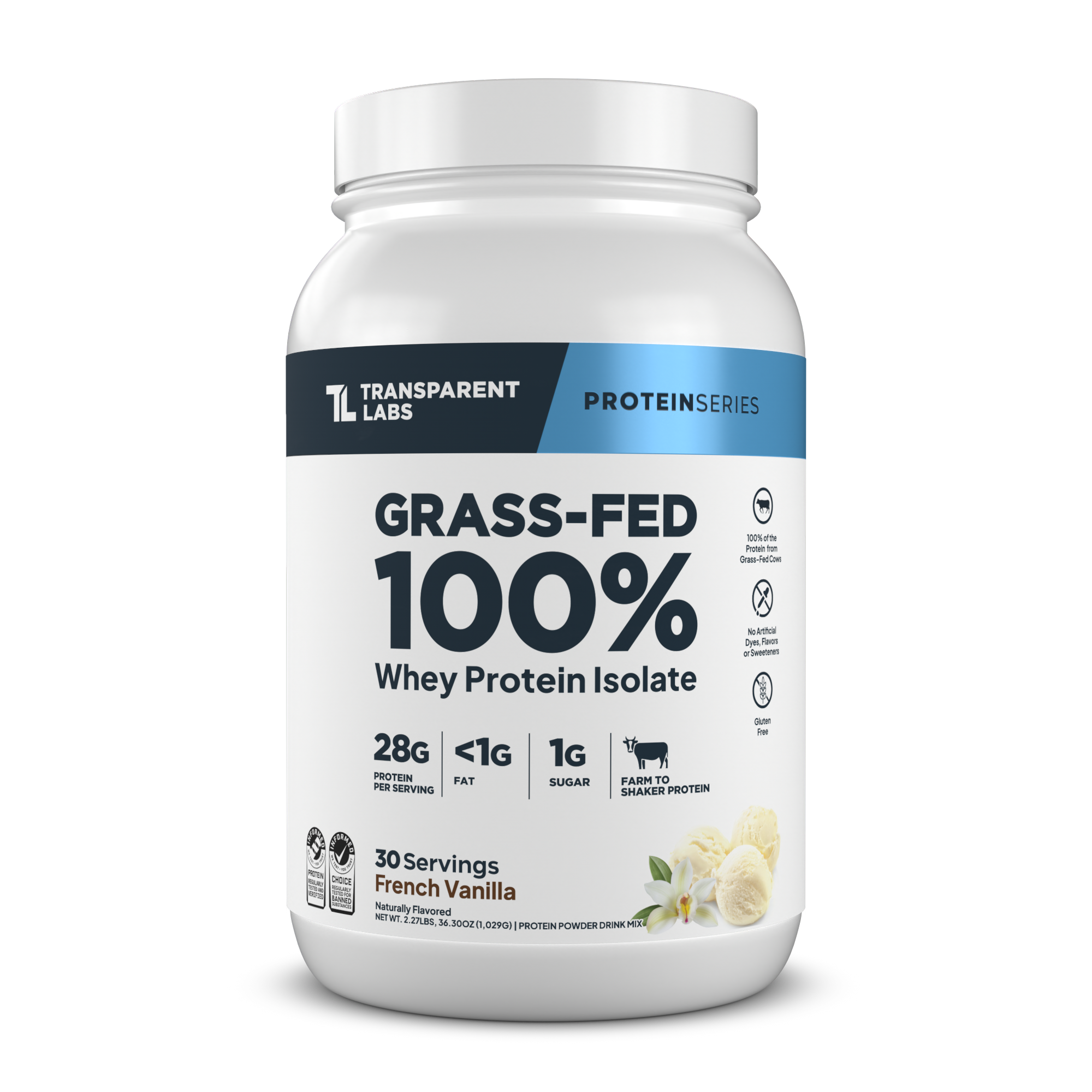
Whey Protein Types: Concentrate vs Isolate vs Hydrolyzed

Whey is a family of three increasingly processed forms. Pick the wrong one and you either overpay or trigger the bloating you were trying to avoid. Here is how to match the form to your goal.
The short answer. Concentrate is the default. Isolate solves lactose problems and tight cuts. Hydrolyzed is a niche upgrade you rarely need.
What "whey" actually is
All whey protein starts in the same place: the watery liquid left behind when milk curdles into cheese. About nine liters of milk produce one liter of liquid whey, and that liquid is only about 0.6 percent protein. The journey from there to a 25 gram scoop in your shaker is a story of filtration and processing depth.
Whey contains a mix of beta-lactoglobulin, alpha-lactalbumin, immunoglobulins, lactoferrin, and growth factors. These bioactive fractions are part of why dairy proteins are so well studied for muscle protein synthesis. Higher processing tends to strip more of these compounds out, trading bioactivity for purity.
The three commercial forms are simply three stopping points along the same processing line. Light filtration produces concentrate. Heavy filtration produces isolate. Enzymatic predigestion of isolate produces hydrolyzed whey.
How each form is made
Concentrate is produced by microfiltration or ultrafiltration: liquid whey is pushed through membranes that hold back protein molecules while letting lactose, minerals and water pass through. Stop early and you end up with 70 to 80 percent protein, with the rest being residual lactose, fat and bioactive compounds.
Isolate uses one of two paths. Cross-flow microfiltration (CFM) uses finer physical membranes to push purity above 85 percent while preserving more native protein structure. Ion-exchange uses charge-based chemistry to reach even higher purity, but tends to denature delicate fractions. Most premium isolates today use CFM.
Hydrolyzed whey takes an isolate base and exposes it to proteases that snip the long protein chains into di-peptides and tri-peptides. The protein percentage stays roughly the same, but the molecule sizes are much smaller, which is why it absorbs slightly faster and sometimes tastes more bitter.
| Process step | Concentrate | Isolate | Hydrolyzed |
|---|---|---|---|
| Typical protein % | 70 to 80 | 85 to 95 | 85 to 95 |
| Lactose per scoop | 3 to 4 g | under 1 g | ~0 g |
| Processing depth | Light | Heavy | Heavy + enzymatic |
| Bioactives retained | Most | Some | Fewest |
| Typical absorption onset | ~30 min | ~20 to 25 min | ~15 to 20 min |
| Mouthfeel | Creamier | Thinner | Thin |
What actually moves the needle
A 2018 meta-analysis in the British Journal of Sports Medicine looked at protein supplementation and resistance training. The headline finding was that total daily protein intake, not the form of that protein, was the dominant driver of strength and muscle outcomes. Form mattered at the margins.
That is the right frame for choosing a whey type. Concentrate gets you the most grams of protein per dollar, isolate gets you the cleanest macro profile, and hydrolyzed gets you the fastest amino spike. The "right" choice depends on which of those three is your actual binding constraint, not on which marketing language is loudest.
For most readers the binding constraint is cost and consistency. A tub you actually finish is better than a fancier tub that sits half-used because it was too expensive to repurchase. Start with concentrate, upgrade only when you hit a specific reason to.
How we rank whey products
Every whey product on ProteinPrice gets a Value Score combining grams of protein per dollar, retailer availability, and serving size flexibility. We pull live retailer prices, normalize to cost per gram of protein, and surface the leaders.
For type-specific shopping, our category pages segment by form so you can compare apples to apples. Browse whey concentrate, whey isolate, or whey blends directly and sort by Value Score.
Common mistakes to avoid
Paying isolate prices for a blend. Many "premium" tubs list isolate first on the ingredient panel but are mostly concentrate by weight. Compare cost per gram of protein, not marketing copy.
Buying hydrolyzed when you do not need it. Unless you have compromised digestion or an explicit clinical reason for faster absorption, the upcharge is almost always wasted.
Assuming lactose-free means isolate. Some plant blends are also lactose-free and cheaper. If lactose is your problem and dairy is not a hard requirement, see our lactose-free protein guide.
A note on whey blends
Many of the bestselling tubs on US shelves are not pure concentrate, isolate, or hydrolyzed. They are blends, often listing isolate first on the ingredient panel for marketing reasons even though concentrate makes up most of the protein by weight. Optimum Nutrition Gold Standard is the most famous example.
The economics behind blends are simple. Concentrate is cheap to manufacture, isolate is expensive, and a 70/30 mix of concentrate to isolate tastes closer to a pure isolate (the isolate fraction cleans up the flavor profile) at near the cost of pure concentrate. This is why blends have dominated the bestseller list for over two decades.
How to read a blend honestly: look at the protein percent per scoop. If a 32 gram scoop delivers 24 to 25 grams of protein, you are looking at roughly 75 to 78 percent protein density, which means mostly concentrate with a small isolate fraction. A pure isolate would deliver 28 to 29 grams of protein in the same scoop weight.
Absorption speed in real numbers
One of the most-marketed differences between the three forms is absorption speed. The research is more modest than the marketing. Across the literature, an apples-to-apples comparison of equal-protein doses looks roughly like this: concentrate amino acids appear in blood at about 30 minutes, peak at 90 minutes, return to baseline at 3 hours. Isolate appears at 20 to 25 minutes, peaks at 60 to 75 minutes, baselines at 2.5 hours. Hydrolyzed appears at 15 to 20 minutes, peaks at 45 to 60 minutes, baselines at 2 hours.
For muscle protein synthesis specifically (the thing you are actually optimizing for) the total area under the amino curve matters far more than peak speed. By that measure, all three forms produce roughly equivalent results at equal protein doses. The speed difference matters in narrow contexts (intra-workout protein, immediate post-event recovery for competitive athletes) and barely moves the needle for the typical post-gym shake.
The takeaway: if you are buying for the speed advantage, the advantage is real but small. If your training schedule does not have a 15-minute-precision recovery window, the form choice is dominated by other factors (cost, lactose tolerance, taste).
The practical verdict
If your gut tolerates dairy and you want maximum protein per dollar, buy a concentrate or a blend. If you bloat or are deep in a cut, move to isolate. Save hydrolyzed for the edge cases where you have already optimized everything else.
The form you choose is a small lever on top of the bigger question of whether you actually hit your daily protein target. A tub of concentrate you finish every month outperforms a tub of premium hydrolyzed you only use three days a week. Consistency wins; form is a secondary optimization.
Pick a tub you can afford to keep buying, set up a recurring schedule, and the rest takes care of itself. Move up the form ladder only when you hit a specific reason to.